
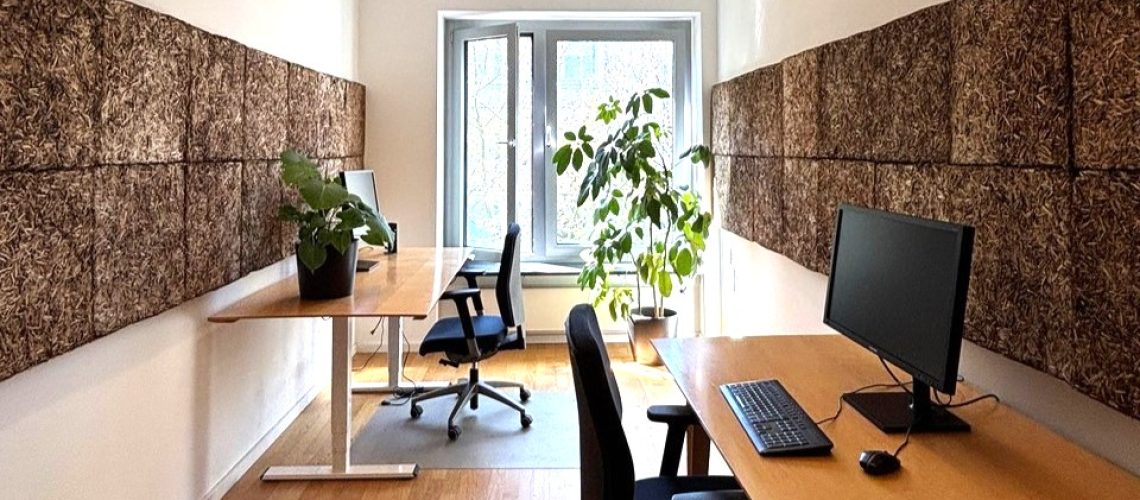
For our Munich office, we were looking for a sustainable soundproofing solution – and found the acoustic panels from onmatter. In this interview with onmatter and our colleague Magdalena Fleischmann, you can learn more about sustainable soundproofing made from hop fibers:
You produce acoustic panels from hop fibers, which can be used to soundproof rooms in a natural and sustainable way. How do these panels work?
onmatter: Our acoustic panels are made entirely from a material we produce from hop residue – specifically, from the vines left over after the harvest. These fibers are processed into lightweight, open-pored panels that absorb sound and, thanks to their structured surface, promote diffuse sound distribution throughout the room. The panels can be mounted on walls and ceilings, creating more pleasant room acoustics – all without any additional binders.
What are the advantages?
onmatter: Our panels combine ecological, technical, and regional advantages: They are made from a previously underutilized agricultural byproduct, thus actively contributing to the circular economy. By fully utilizing this renewable raw material, we not only avoid waste but also create a 100% bio-based product. Technically, the panels impress with their excellent sound absorption, light weight, and open, breathable structure. They noticeably improve room acoustics and simultaneously contribute to a healthy indoor climate. Another key aspect is regional sourcing: The raw material originates from the hop-growing region of southern Germany, and processing and manufacturing also take place in the region. This not only ensures short transport routes and transparent supply chains but also promotes local value creation and craftsmanship.
Magdalena Fleischmann: As the environmental management officer for the EMAS system at Arqum, it was important to me to implement an environmentally friendly solution for soundproofing in our office. The company onmatter also impressed us technically: the sound has improved significantly, which is particularly noticeable in comparison to other offices. The reverberation time in the office has been reduced by 43,8% from 1,30 seconds to 0,73 seconds thanks to the panels – and even to 0,57 seconds with furniture and plants. These are optimal results!
Why do you use hops in particular?
onmatter: Hops are an exciting, largely untapped plant raw material with many unused potentials. The stems, in particular, are produced in large quantities as a byproduct and have excellent fiber structures that are very well suited for lightweight construction and acoustics. Furthermore, hops have a long cultural connection to our region – which makes them especially interesting for us from a bioregional perspective.
Magdalena Fleischmann: At first, we were concerned that the hop-colored panels, with their brown tones, might make the office too dark. Together with the onmatter team, we found a great solution: the panels were installed as a continuous strip, so there are still plenty of light-colored areas. I now find the office really cozy and I'm curious to see how the atmosphere changes with the seasons!
How do the costs compare to other soundproofing materials?
onmatter: Our panels are priced in the mid-range: more affordable than many premium designer acoustic products, but slightly more expensive than conventional foams. We focus on fair prices and want to demonstrate that sustainable materials can also be economically viable – especially when factors such as indoor climate, design, and origin are taken into account.
In addition to acoustic panels, onmatter offers a range of innovative and sustainable building materials for various applications, with which you can revolutionize the construction industry…
onmatter: Yes, we have a bigger vision: With our bio-based recycled building materials, we want to demonstrate that ecological innovations can work not only in the lab, but also in real-world situations. The hop office at Arqum is a true milestone for us, one from which we can learn a great deal and which we want to develop further together.
Further information on sustainable acoustic panels and other ecological building materials can be found on the onmatter website.
Your contact person at Arqum: Magdalena Fleischmann