As part of the European Commission's Green Deal, the existing Industrial Emissions Directive (IED) has been revised. The amendment (EU 2024/1785) entered into force on August 4, 2024. You can view the current version here.
The IED regulates the permitting, operation, monitoring, and decommissioning of the most environmentally relevant industrial installations in Europe. In Germany, this currently affects approximately 13.000 installations, and in the EU, just over 50.000. Due to the amendment to the IED, these installations will be required to operate an environmental management system in the future. The following applies:
- The obligation to implement an environmental management system is mandatory for all installations falling within the scope of the IED.
- The environmental management system should be in place by [date]. July 2027 It must be implemented and must undergo an external audit every three years.
The environmental management system is intended to ensure continuous improvement of environmental performance and plant safety, with a particular focus on:
- Avoiding the generation of waste,
- Optimization of resource use, energy consumption and water reuse,
- Avoidance or reduction of the use or emission of hazardous substances.
The specific targets and performance indicators should refer to industry-specific benchmarks (according to the BAT conclusions ) as well as target values for environmental performance that are yet to be defined.
Furthermore, there are additional requirements:
- The introduction of a Hazardous materials management for particularly hazardous substances, as well as
- the development and implementation of a Transformation plan with a publication requirement for the period 2030–2050, in order to contribute to the development of a sustainable, climate-neutral and resource-efficient economy.
The IED does not specify a particular standard for the establishment of an environmental management system. However, considering the aforementioned requirements and the obligation for external certification, both ISO 14001 and the EMAS Regulation are suitable, especially since the audit must be carried out every three years by an environmental verifier or auditor.
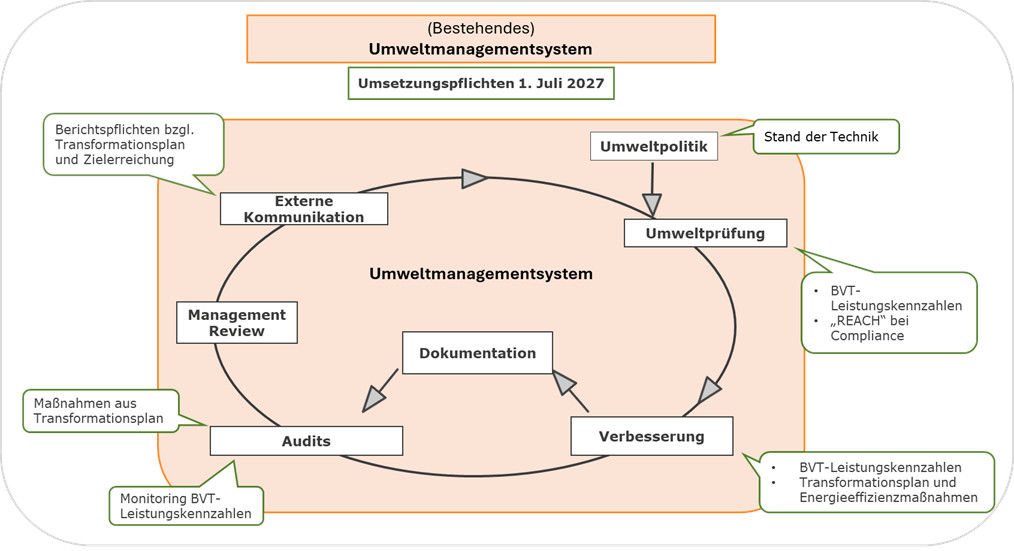
The following graphic illustrates how the IED requirements could be integrated into an environmental management system according to ISO 14001 or EMAS.
Germany now has until July 1, 2026 , to transpose the IED into German law, with the IED setting the minimum requirements. Currently, a draft of the 45th Federal Immission Control Ordinance (45. BImSchV) exists for the planned implementation and is still undergoing consultation with interested parties.
Generally speaking, the German draft is based on the content of the IED, but in some areas it sets significantly more specific requirements. It remains to be seen what level of requirements will ultimately be legally mandated for IED installations.
Many aspects are still under discussion. We present the current status in free webinars about IED implementation in Germany.
Your contact person at Arqum: Uwe Götz
Version of 20.08.2025
The content on this page reflects the current state of affairs at the time of publication. Please note that the legal situation may change in the future.