
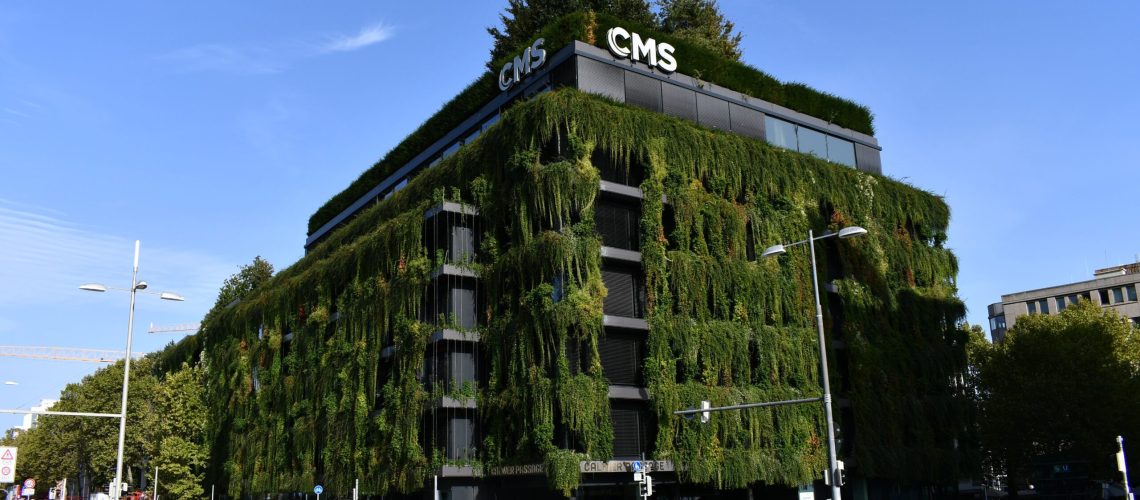
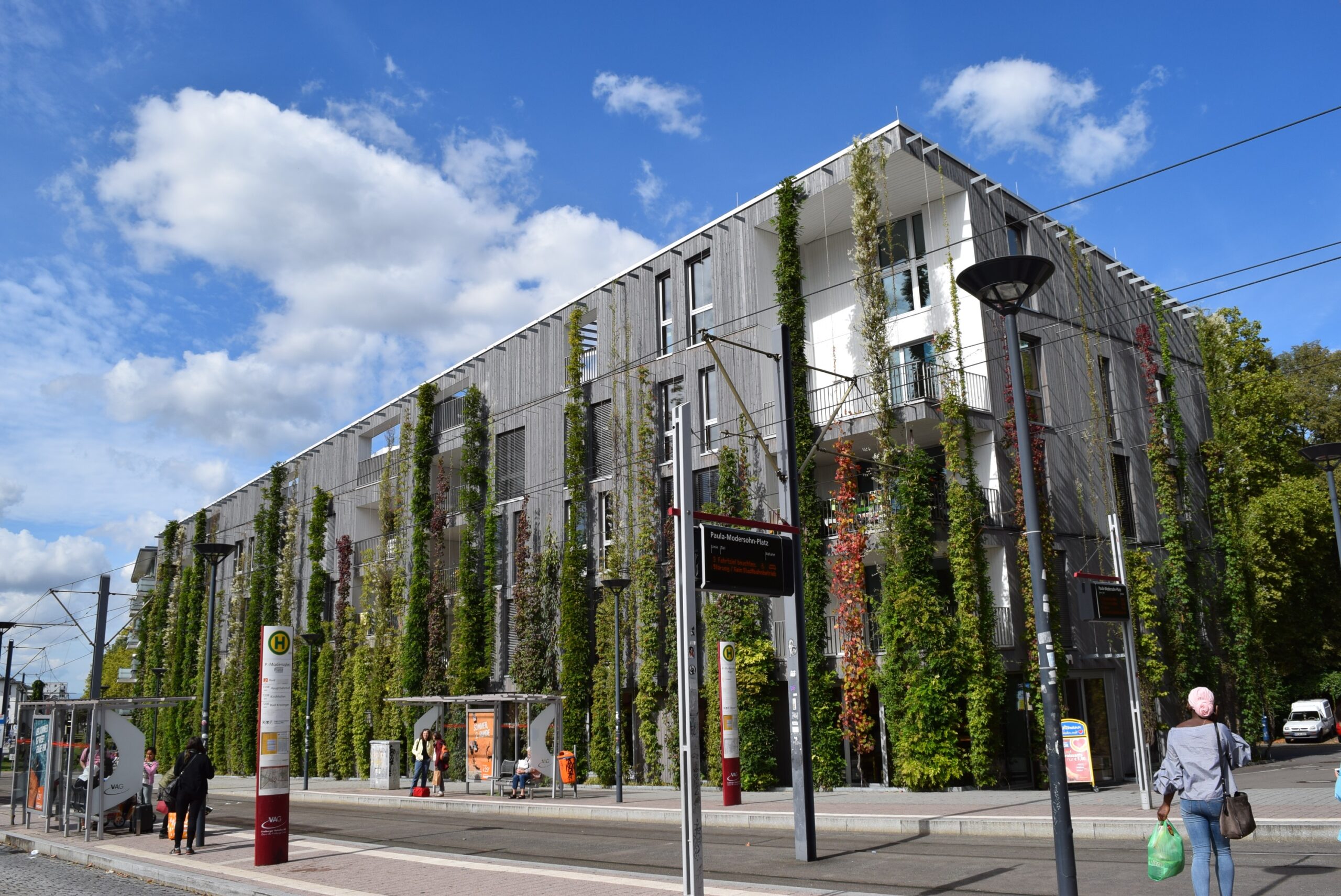
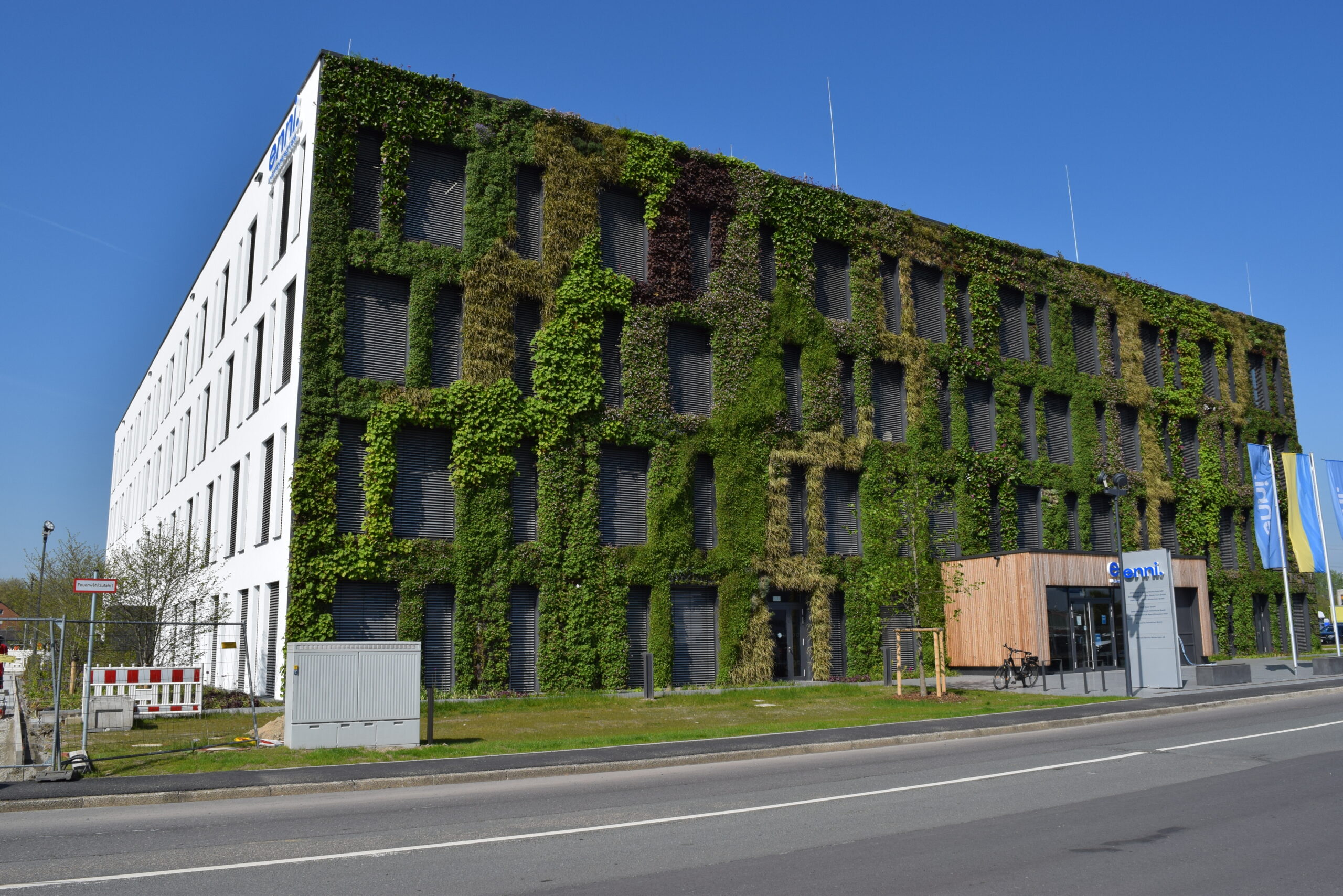
Green facades are true all-rounders and an indispensable part of modern green space planning: They are a visual highlight, bring color and a pleasant atmosphere to gray industrial areas, and offer a whole host of ecological and economic advantages. Above all, green facades are true space-saving wonders that require very little area. This allows companies whose locations are in densely built-up areas, where there are often tall facades but no space for compensatory green spaces, to benefit as well.
Advantages of facade greening
- Improving air quality: The plants bind particulate matter and air pollutants, absorb carbon dioxide, and produce oxygen. According to NABU (Nature and Biodiversity Conservation Union), the leaves of green facades can bind up to 40 percent of nitrogen dioxide, and even up to 60 percent of sulfur dioxide, ozone, and particulate matter.
- Improved local climate: Sealed surfaces heat up more quickly due to the lack of evaporation. Green facades, through their evaporation capacity, shading, and water retention, ensure higher humidity and thus a noticeable regulation of the local climate.
- Lower energy costs: The heat-regulating effect of the green walls protects the rooms from intense sunlight in summer; in winter, the facade greening with evergreen plants has an insulating function. This reduces energy consumption and the costs for air conditioning and heating.
- Facade protection: The plants protect the walls from damage caused by temperature fluctuations, UV radiation, hail, pollutants, and dirt. This results in lower building maintenance costs.
- Noise protection: By reducing sound reflection, the noise level at the building is reduced by up to 10 decibels. The more lush the vegetation, the greater the noise protection.
- Compensatory measures for new buildings: For new buildings that impact the natural environment and landscape, developers must implement compensatory measures under nature conservation law, such as planting trees. Alternatively, the facade can be greened.
- More biodiversity: Wall greening creates an urban habitat for many plants and animals, thus increasing biodiversity in the city – especially when the facade greening consists of native plant species suited to the location.
- Attractiveness of the company premises: A green facade is attractive and can positively influence a company's image. Employees also appreciate green oases on company premises.
Tips for Companies
- Conduct a location analysisCheck the design and condition of the facade in terms of load-bearing capacity and suitability for a floor- or wall-mounted construction. Consider additional wind suction loads, especially for taller buildings.
- Make the right choice of plantsChoose low-maintenance, site-appropriate plants that require little upkeep.
- Seek professional adviceAn expert can help you find the best greening system for your needs. For example, you can find out more from... BuGG Federal Association for Green Buildings e. V. or use, for example, the Planning aid from the Federal Association of Garden, Landscape and Sports Field Construction eV
- Involve employeesFacade greening can be part of a company-wide sustainability strategy and be maintained through employee initiatives.
- Fördermöglichkeiten prüfenFind out more! Municipalities and government programs offer financial support for the implementation of green facades.
How much does it cost to green a facade?
Ground-based systems with simple climbing plants, without trellises or irrigation systems, can be implemented starting at €15 per square meter. Depending on the complexity, costs can reach up to €300 per square meter. Ongoing maintenance costs are approximately €5-10 per square meter per year.
Wall-mounted systems are available for €400-1.000 per square meter. Maintenance costs amount to approximately €10-15 per square meter per year.
Your contact person at Arqum: Christian Heinrichs
Photos: German Association for Green Buildings